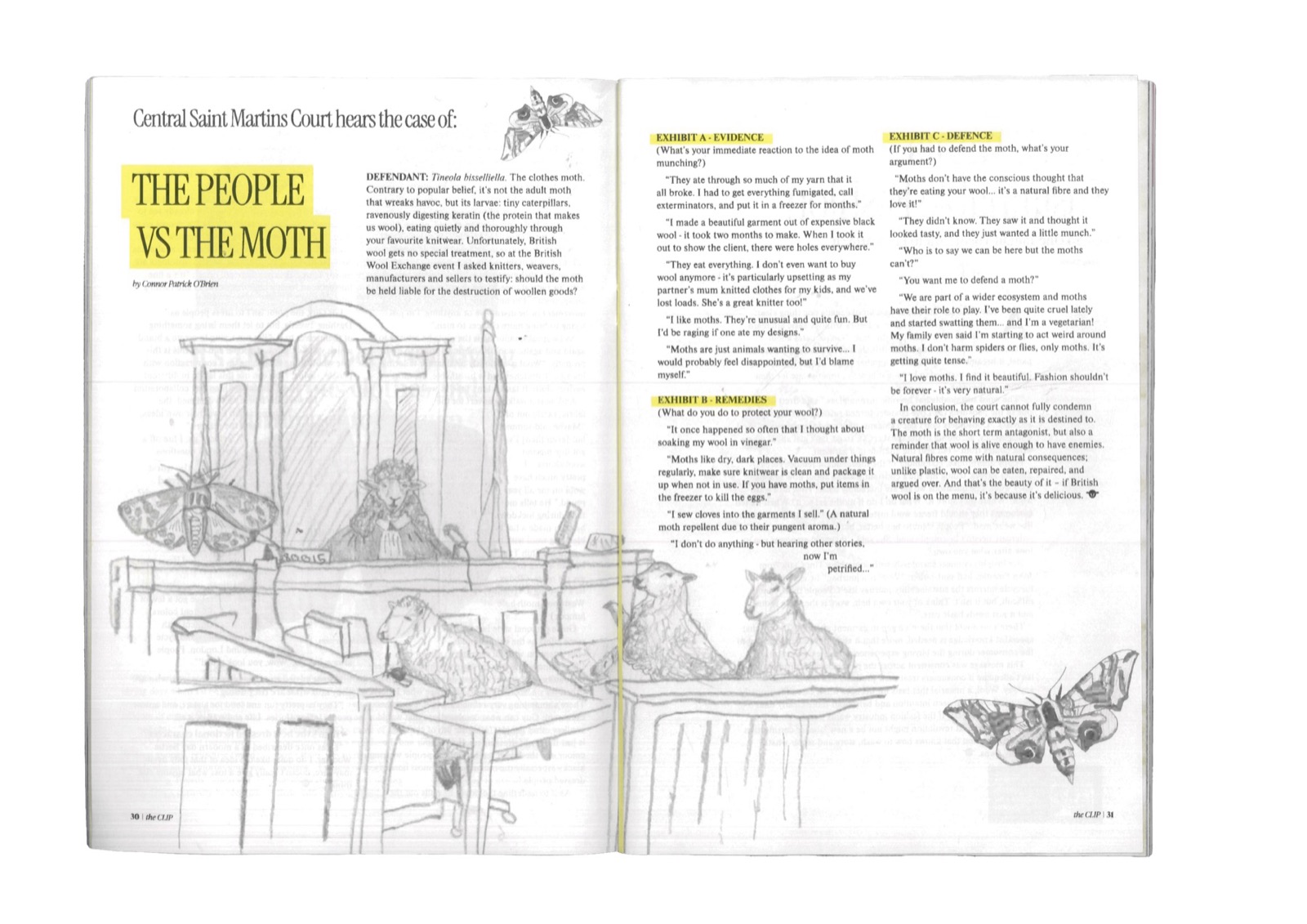
Defendant: Tineola bisselliella. The clothes moth. Contrary to popular belief, it’s not the adult moth that wreaks havoc, but its larvae: tiny caterpillars, ravenously digesting keratin (the protein found in wool), eating quietly and thoroughly through your favourite knitwear. Unfortunately, British wool gets no special treatment, so at the British Wool Exchange I asked knitters, weavers, manufacturers and sellers to testify: should the moth be held liable for the destruction of woollen goods?
EXHIBIT A — EVIDENCE
What happened? If nothing, what’s your immediate reaction to the idea of moth munching?
“They ate through so much of my yarn that it all broke. I had to get everything fumigated, call exterminators, and put it in a freezer for months.”
“I made a beautiful garment out of expensive black wool — it took two months to make. When I took it out to show the client, there were holes everywhere.”
“They eat everything. I don’t even want to buy wool anymore — it’s particularly upsetting as my partner’s mum knitted clothes for my kids, and we’ve lost loads. She's a good knitter too!”
“I like moths. They’re unusual and quite fun. But I’d be raging if one ate my designs.”
“Moths are just animals wanting to survive... I would probably feel disappointed, but I’d blame myself.”
EXHIBIT B — REMEDIES
What do you do to protect your wool?
“It once happened so often that I thought about soaking my wool in vinegar.”
“Moths like dry, dark places. Vacuum under things regularly, make sure knitwear is clean and package it up when not in use. If you have moths, put items in the freezer to kill the eggs.”
“I sew cloves into the garments I sell.” (A natural moth repellent due to their pungent aroma.)
“I don’t do anything — but hearing other stories, now I’m petrified…”
EXHIBIT C — DEFENCE
If you had to defend the moth, what’s your argument?
“Moths don’t have the conscious thought that they’re eating your wool… it’s a natural fibre and they love it!”
“They didn’t know. They saw it and thought it looked tasty, and they just wanted a little munch.”
“Who is to say we can be here but the moths can’t?”
“You want me to defend a moth?”
“We are part of a wider ecosystem and moths have their role to play. I’ve been quite cruel lately and started swatting them… and I’m a vegetarian! My family even said I’m starting to act weird around moths. I don’t harm spiders or flies, only moths. It’s getting quite tense.”
“I love moths. I find it beautiful. Fashion shouldn’t be forever — it's very natural.”
In conclusion, the court cannot fully condemn a creature for behaving exactly as it is destined to. The moth is the short term antagonist, but also a reminder that wool is alive enough to have enemies. Natural fibres come with natural consequences; unlike plastic, wool can be eaten, repaired, and argued over. And that’s the beauty of it — if British wool is on the menu, it's because it’s delicious.