Fashion loves a filter - airbrushed, exaggerated depth, performative intellectualism. The inspiration behind the collection? A Renaissance painting, a tragic 14th-century tapestry. HongJi doesn’t care - he’s just being real. A final year womenswear student at Central Saint Martins (CSM), he points out the filter whilst refusing to use one himself, finding inspiration in the things that aren’t supposed to be profound.
His ‘world’ isn’t separate from ours – it’s the one we live in, where attention is currency. Instead of searching for depth in historical archives, he reveals what’s already here, fleetingly and flashing before our screens. “I reference what’s kind of a ‘joke’ and stuff,” he says. The TaoBao ad, the delivery driver, the influencer livestream - where others hunt for meaning, he finds it in the shallow. “I’ve never done projects that have nothing to do with me, like museums. It’s always things that I’m interested in, things that I see online, like TikToks.” His work is not an homage to history, but a reminder of the present. HongJi doesn’t want us to escape reality, but to wear it.
I used to steal my mum’s Cartier watches, wearing them to primary school.
He scrolls so much he deleted Douyin (Chinese TikTok.). “I used to watch a trans influencer always battling people online,” he says. “But after I sent her a gift, she said it wasn’t enough. I was like, ‘bitch!’”
HongJi didn’t find fashion. He stole it. “I used to steal my mum’s Cartier watches, wearing them to primary school.” As a kid growing up in Beijing, he admits that he was attention-seeking: “I think the journey started from the ego of wanting to be seen by others, because I always felt left out. I wanted to show that I was the one people should watch out for.” If they wouldn’t watch out for him, he’d at least have the watches.
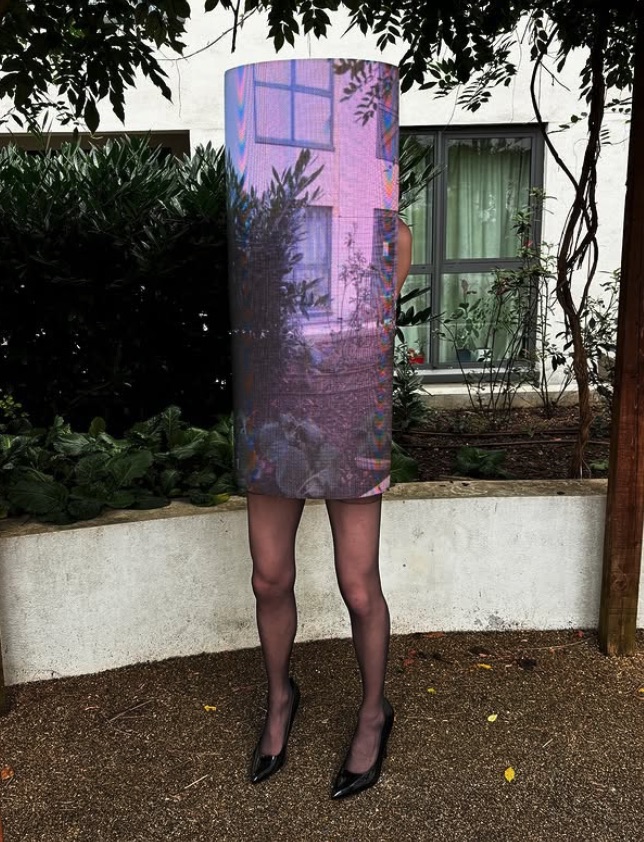
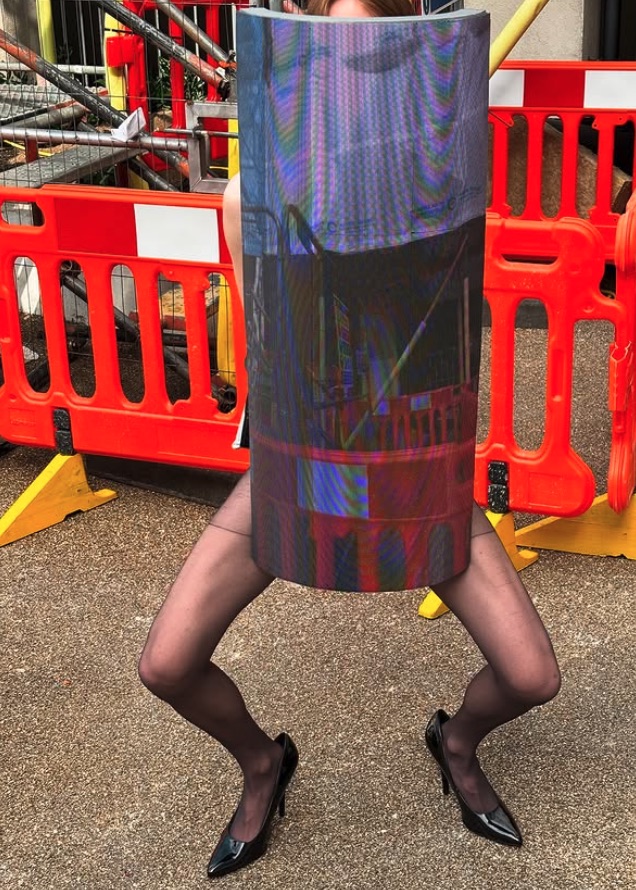
In his graduate collection, HongJi asks a simple question: do we even know these people we superficially encounter daily, especially in the online realm? He focuses on a cyclical connection between influencers and delivery drivers. “They’re both invisible, creating an interesting system: delivery guys finish their deliveries and scroll on their phones watching influencers, and when influencers finish their lives, they order delivery food.” Although seemingly contrasting entities, they are both invisible in their own ways. “The influencer side is the invisibility of not knowing their true colors. For delivery drivers, you won’t remember their names or faces.” Although they seem to share obscurity, their clothing ironically demands attention: delivery drivers wear neon vests and reflective strips that ensure they stand out, influencers use sequins, flashy gold, and bold brand logos that create a presence designed for digital consumption. This contrast forms a paradox of hyper-visibility. Some of HongJi’s designs are literal - one uses screens that project the audience back to themselves, not only functioning as a meta effect, but also igniting self-reflection.
For HongJi, sustainability is the ominous word that haunts every fashion conversation. “It’s boring right now. Fashion is too sensitive about everything. My collection isn’t fully about sustainability, it’s more about telling a story. I don’t agree with the idea of making students be that sustainable, because we have to explore. I feel limited sometimes.” But HongJi has made adjustments - swapping PVC for TPU, experimenting with zero-waste pattern cutting - ultimately, his focus is narrative-driven.
Casting reflects his ethos - real people. “I want them to be a bit different, but not ‘glamour’ glamour.” No statuesque supermodels, no predictable beauty. Instead, a mix of young faces that feel like they belong in his vision. “Before I was thinking I wanted all types of models, but right now, I’ve narrowed it down to all young models - but people that you would see in real life.”
Talk to him about the industry, and he stays just as transparent. HongJi knows what he’s up against – he’s been in the industry, working placements at Off-White, Bless, and UNTITLAB. He’s been inside the machine, where talent alone isn’t enough – so starting his own brand isn’t on the table… at least not alone. “I’m thinking me and some friends can work together. CSM is a great place to make connections, I’ve got a lot of friends doing Fashion Communication: Image and Promotion (FCP) - we could start consulting; sew for the client, shoot… do everything.” He’s not waiting for a seat at the table, he’s bringing his own chair.
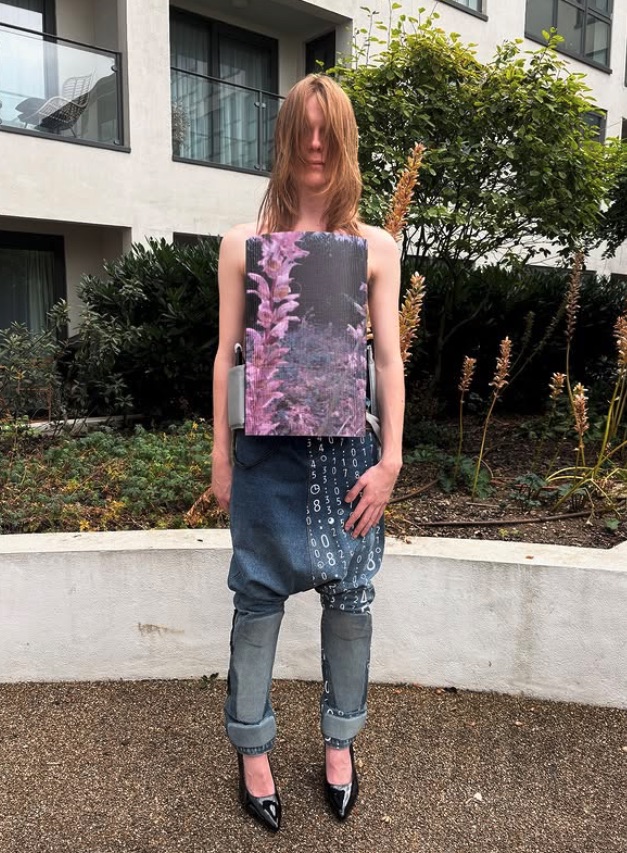
His garments harness attention. They aura-farm. Like push notifications reminding us of our own chaotic, fleeting culture. His shows are a live stream of the now - one big inside joke that everyone’s already in on - no show notes necessary. He doesn’t want to escape the content spiral, but find meaning in it that we might have otherwise scrolled past. “Because I can’t concentrate, I’m randomly scrolling on my phone, things pop up, and I just think, ‘oh that’s so fun!’” He screenshots the internet and turns it into a fit. You were tagged. You just didn’t realise it.
HongJi’s work exists in the spaces between commercial and conceptual, between digital and tangible, between seen and unseen. Whilst everyone else is airbrushed, HongJi is unfiltered. It’s not ‘postmodern’. Just post-pretentious.